By TechMilkyWay | Navigate The Tech Universe.
Introduction
GaN PD & PPS charging explained — that’s exactly what this ultimate guide is all about. If you’ve ever stared at a charger spec sheet and felt completely lost, you’re not alone. At TechMilkyWay, we break down GaN (Gallium Nitride), USB Power Delivery (PD), and PPS (Programmable Power Supply) in plain English — so you can charge smarter, shop better, and stop wasting money on the wrong charger. By the end of this guide, you’ll know exactly what each technology does and why all three matter.
GaN PD & PPS Charging Explained: What Is GaN?
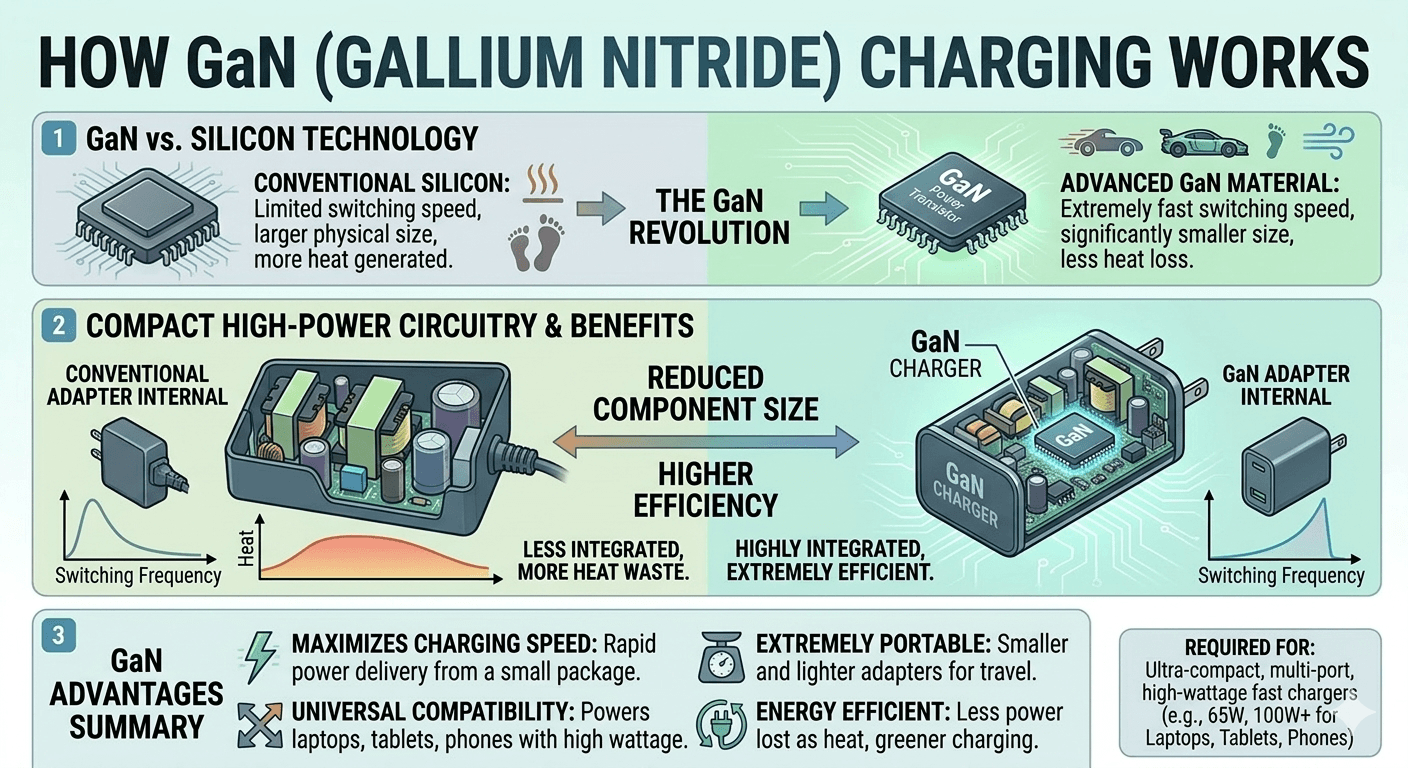
For decades, chargers were built around one material: silicon. It worked — but it had real limits. Silicon generates a lot of heat when handling high power, which forced manufacturers to make chargers big, heavy, and bulky just to manage that heat safely.
Then came Gallium Nitride — GaN.
GaN is a semiconductor material that handles electricity far more efficiently than silicon. It switches power faster, wastes less energy as heat, and stays cooler under load. The result? Chargers that are dramatically smaller, lighter, and more powerful than anything silicon could deliver.
Think of it this way: a traditional 65W silicon charger is roughly the size of a deck of cards. A GaN charger delivering the same 65W can be the size of a standard wall plug. Some GaN bricks even squeeze 100W or more into a form factor that looks like a regular phone charger.
Key benefits of GaN chargers:
- Significantly more compact and travel-friendly
- Runs cooler, reducing wear on both the charger and your device
- Supports higher wattage without the bulk
- Perfect for multi-port chargers — more ports, less heat
GaN doesn’t change how your device is charged — it changes how efficiently the charger does its job. Think of it as the engine under the hood.
GaN PD & PPS Charging Explained: What Is USB Power Delivery (PD)?
If GaN is the engine, USB Power Delivery (USB PD) is the communication system.
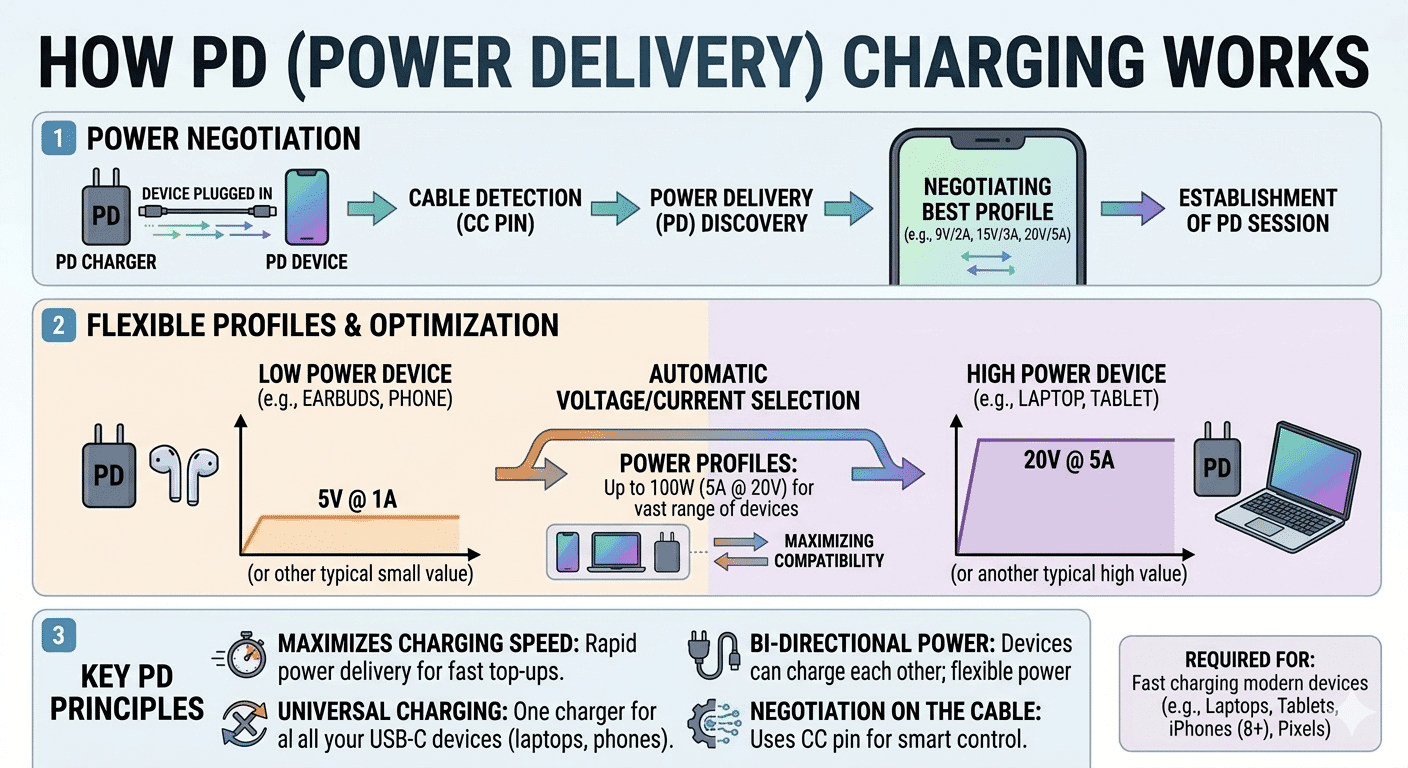
USB PD is an industry-wide charging standard that allows a charger and a device to have a conversation before power flows. Instead of blindly pushing electricity, a PD charger asks your device: “How much power do you need, and at what voltage?” Your device responds, and both sides agree on the safest, fastest delivery possible.
This negotiation happens over the USB-C cable in milliseconds — and it’s what makes USB PD so versatile. The same charger can safely power a smartphone, a tablet, a laptop, or a Nintendo Switch, because each device tells the charger exactly what it needs.
The latest version, USB PD 3.1, supports up to 240 watts over a single USB-C cable — enough to charge a high-performance gaming laptop at full speed.
Why USB PD matters to you:
- One charger for all your USB-C devices — no more carrying multiple bricks
- Devices are protected from receiving more power than they can handle
- Universally supported across brands — Apple, Samsung, Google, Lenovo, and more
- Replaced a confusing patchwork of proprietary fast-charging standards
If your charger and your device both support USB PD, you’re already benefiting from smarter, safer fast charging.
GaN PD & PPS Charging Explained: What Is PPS?
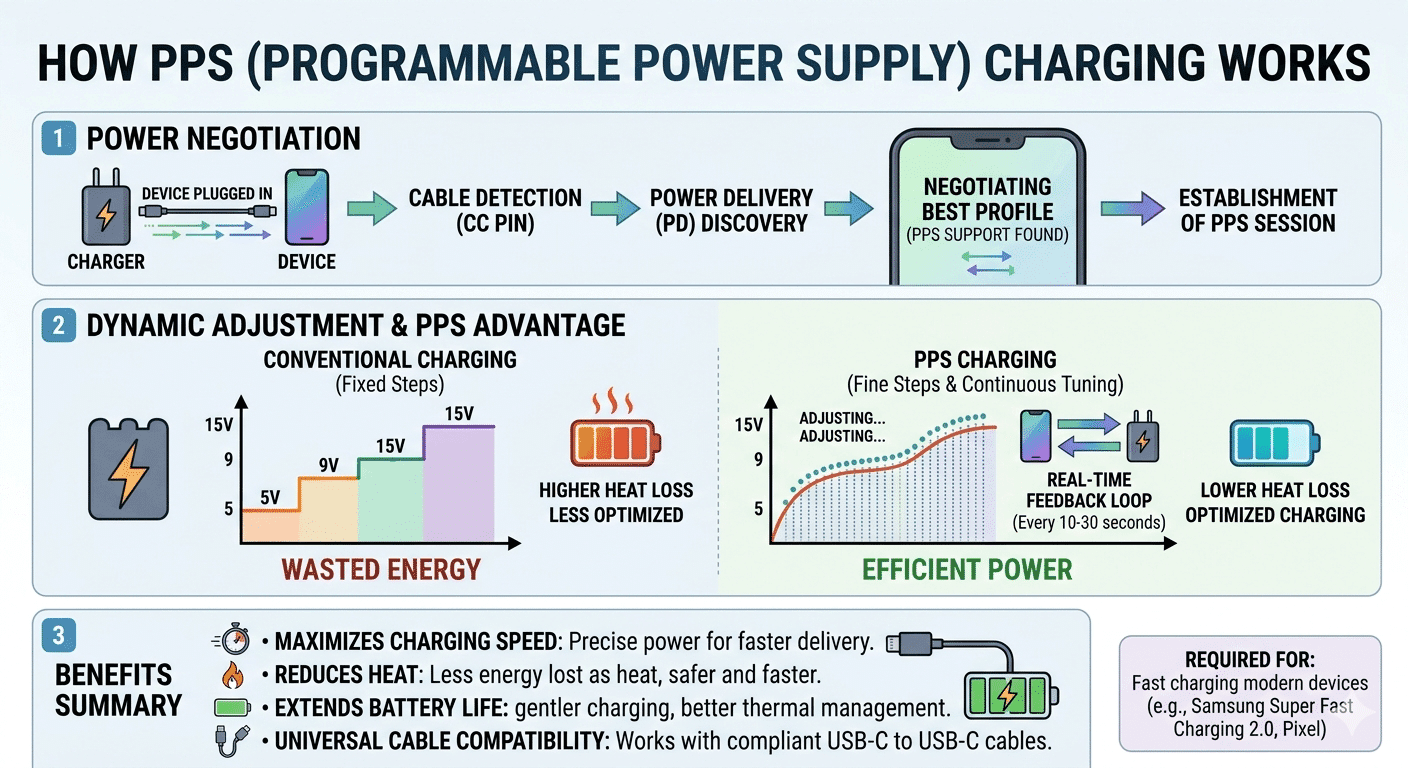
USB PD is great — but it has one limitation. It delivers power in fixed voltage steps: 5V, 9V, 15V, 20V. Your device then has to convert that voltage internally to match what the battery needs at any given moment. That internal conversion generates heat — inside your phone, right next to the battery.
Programmable Power Supply (PPS) solves this elegantly.
PPS is an extension of the USB PD 3.0 standard that removes those fixed voltage steps and replaces them with a continuous, fine-grained range. Instead of jumping between preset levels, a PPS charger can deliver any voltage between roughly 3.3V and 21V, adjusting in real time in tiny 20mV increments.
What this means in practice: the voltage conversion that normally happens inside your device now happens outside it, in the charger. Your device receives exactly the voltage it needs at each stage of the charge cycle — no internal conversion, no unnecessary heat.
The real-world benefits of PPS:
- Faster charging with less heat generated inside the device
- Better long-term battery health due to reduced thermal stress
- More consistent charging speed from 0% to 100%
- Powers next-gen fast charging like Samsung Super Fast Charging 2.0 and Qualcomm Quick Charge 5
PPS is the reason your phone can charge to 50% in 15 minutes without getting uncomfortably hot. It’s precision engineering, quietly working in the background.
GaN vs PD vs PPS: What’s the Difference?
It’s easy to confuse these three because they often appear together on the same charger’s spec sheet. Here’s a simple breakdown:
| Technology | What It Is | What It Does |
|---|---|---|
| GaN | A hardware material | Makes the charger smaller, cooler, and more efficient |
| USB PD | A charging protocol | Lets charger and device negotiate safe power levels |
| PPS | An extension of USB PD | Fine-tunes voltage in real time for optimal charging |
They aren’t competing — they’re complementary. The best chargers on the market today use all three together.
Do You Actually Need All Three?
Gen PD & PPS changing Explained, Here’s the honest TechMilkyWay take:
GaN — Yes, if you’re buying a new charger. There’s no good reason to choose a silicon charger anymore. GaN options are widely available and increasingly affordable.
USB PD — Absolutely. If you own any USB-C device made in the last four years, you almost certainly already have PD support. Make sure your charger does too.
PPS — It depends on your device. PPS is most impactful on flagship Android phones — Samsung Galaxy S series, Google Pixel, and others — that are specifically designed around PPS-based fast charging. iPhone users benefit from USB PD but don’t currently leverage PPS in the same way. Still, buying a PPS-capable charger future-proofs your setup.
🔗 Also read: Best Smartphones of 2026Most Popular Microphone for Content Creators: Hollyland Lark M2 Review
The Bottom Line
GaN PD & PPS charging explained in one sentence: GaN makes your charger compact and efficient, USB PD makes it smart and universal, and PPS makes it precise and gentle on your battery.
Together, they represent a genuine leap forward from the slow, hot, one-size-fits-all chargers of the past. Next time you’re shopping for a charger, look for all three on the label. Your devices — and your battery life — will thank you.
🌌 TechMilkyWay
Navigating the Tech Universe
TechMilkyWay provides research-based product reviews, technology insights and gaming update to help you make informed and purchasing decisions. Our reviews are independent, thorough, and focused on real-world value.
Quick Links: Home | About Us | Contact Us | Facebook
Contact: mdfariv33@gmail.com
⚠️ Disclosure: Picture used only for understanding purposes and Ai generated. Thank you for supporting TechMilkyWay! 🚀
© 2026 TechMilkyWay. All rights reserved.